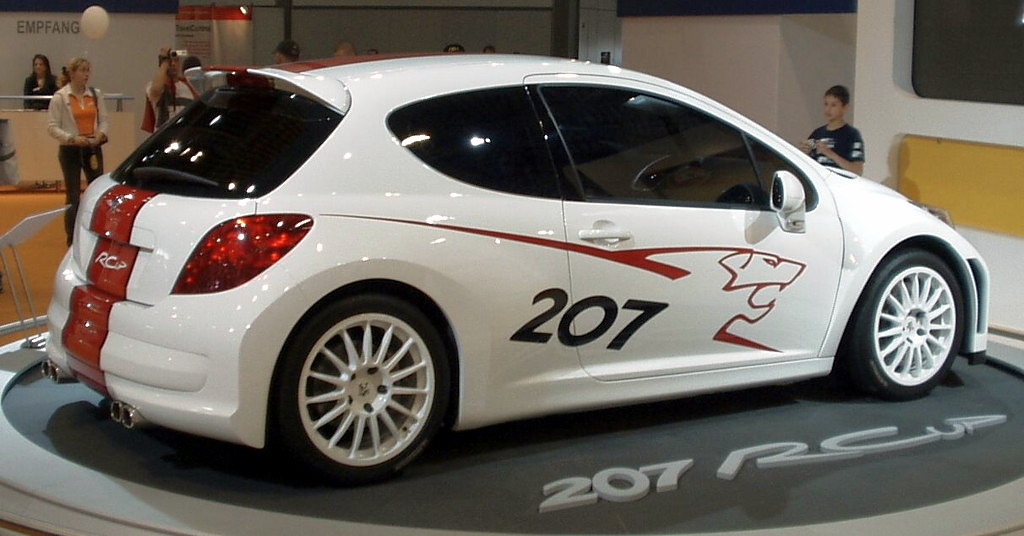
The Peugeot 207 is a supermini produced by the French automaker Peugeot and unveiled in January 2006. According to JATO Dynamics, an automative market researcher, the model was the bestselling car in Europe in 2007. The 207 was launched in France, Spain and Italy during April 2006 and later on in other European, Israeli and Arabic markets. The UK launch was on 8 June 2006. Amicus and the TGWU, both unions representing workers at PSA's UK manufacturing plant in Ryton, Coventry, chose the same day to launch a campaign calling for the boycott of PSA's Peugeot and Citroën vehicles in the UK. The campaign was in protest against the company's plans to close the Ryton plant. Despite the boycott the sales of Peugeot in UK grew. Not to be confused with the 207 in the Brazilian market. That model is essentially a 206+ sold in some European markets. The 207 is the successor to the 206. The 207 is based on a modified version of the platform used for the Citroën C3, and is built in Poissy and a new plant near Trnava, Slovakia. Initially three petrol engines were available: 1.4-litre 8v with 75 or 16v 90 hp (67 kW) and 1.6-litre 16v with 110 bhp (82 kW; 112 PS). From late 2006, the 1.4 & 1.6 16v models were replaced by the new 1.4 vti 95 bhp (71 kW; 96 PS) and 1.6 vti a 120 bhp (89 kW; 122 PS) Valvetronic engines. Two turbocharged versions, one with 150 bhp (112 kW; 152 PS) , and the other with 175 bhp (130 kW; 177 PS) were also added to the range. The latter four engines result from the cooperation agreement between PSA and the BMW group. The diesel-powered engines available are a 1.4 litre 70 hp (52 kW) or a 1.6 litre HDi with maximum output of 90 or 110 hp (82 kW), the latter with the addition of an intercooler. The 207 is available as a three- or five-door hatchback, a 207 SW Station Wagon and a 207 CC coupé convertible. A GTI version is available with the 175 hp (130 kW) turbocharged 1.6 litre engine. It has sold well in Britain, being the sixth best selling car overall (and third in the supermini sector) in 2007 with more than 67,000 examples being sold.Saturday, April 16, 2011
Peugeot 207
The Peugeot 207 is a supermini produced by the French automaker Peugeot and unveiled in January 2006. According to JATO Dynamics, an automative market researcher, the model was the bestselling car in Europe in 2007. The 207 was launched in France, Spain and Italy during April 2006 and later on in other European, Israeli and Arabic markets. The UK launch was on 8 June 2006. Amicus and the TGWU, both unions representing workers at PSA's UK manufacturing plant in Ryton, Coventry, chose the same day to launch a campaign calling for the boycott of PSA's Peugeot and Citroën vehicles in the UK. The campaign was in protest against the company's plans to close the Ryton plant. Despite the boycott the sales of Peugeot in UK grew. Not to be confused with the 207 in the Brazilian market. That model is essentially a 206+ sold in some European markets. The 207 is the successor to the 206. The 207 is based on a modified version of the platform used for the Citroën C3, and is built in Poissy and a new plant near Trnava, Slovakia. Initially three petrol engines were available: 1.4-litre 8v with 75 or 16v 90 hp (67 kW) and 1.6-litre 16v with 110 bhp (82 kW; 112 PS). From late 2006, the 1.4 & 1.6 16v models were replaced by the new 1.4 vti 95 bhp (71 kW; 96 PS) and 1.6 vti a 120 bhp (89 kW; 122 PS) Valvetronic engines. Two turbocharged versions, one with 150 bhp (112 kW; 152 PS) , and the other with 175 bhp (130 kW; 177 PS) were also added to the range. The latter four engines result from the cooperation agreement between PSA and the BMW group. The diesel-powered engines available are a 1.4 litre 70 hp (52 kW) or a 1.6 litre HDi with maximum output of 90 or 110 hp (82 kW), the latter with the addition of an intercooler. The 207 is available as a three- or five-door hatchback, a 207 SW Station Wagon and a 207 CC coupé convertible. A GTI version is available with the 175 hp (130 kW) turbocharged 1.6 litre engine. It has sold well in Britain, being the sixth best selling car overall (and third in the supermini sector) in 2007 with more than 67,000 examples being sold.Friday, March 25, 2011
2011 Peugeot 206
Impressive 2011 Peugeot 206Thursday, March 3, 2011
2011 Peugeot RCZ

Exotic White 2011 Peugeot RCZ

Elegant 2011 Peugeot RCZ

2011 Peugeot RCZ Elegant Interior

2011 Peugeot RCZ Concept
Sporty 2011 Peugeot RCZ For Racing

2011 Peugeot RCZ Hatchback
2011 Peugeot RCZ Interior View
2011 Peugeot RCZ Cool Wheels
2011 Peugeot RCZ Rare Side View
Friday, January 21, 2011
Peugeot 307
The 307s makes use of a reworked 306 platform, that can also be found on the Citroën Xsara as well as the 1991 Citroën ZX. However, the car is larger than the 306 in every direction. The 307 continued the company's styling first seen on the Peugeot 206 and Peugeot 607. With upswept front lights and a steeply rising bonnet leading to a highly sloped windscreen (and the upright rear doors first seen on the 206), the 307 departed from the Pininfarina-designed themes employed on the previous two generations of Peugeots, as introduced with the Peugeot 205, and ending with the (evolutionary) Peugeot 406. Its height is 1,510 mm (59.4 in), which is in the middle of the spectrum between small family cars (between 1400 and 1450 mm) and compact MPVs (between 1600 and 1650 mm). Some consider the 307 as a low compact MPV rather than a tall small family car, because of its height and profile.Saturday, January 15, 2011
2010 Peugeot 107 Millesim 200
The special edition version of the 107 is based on the current Urban Plus model but benefits from a range of extra standard equipment including 14-inch alloy wheels, air-conditioning, rev counter, special code blue seat trim, blue air vent surrounds, blue instrument binnacle and unique Millesim 200 badging. The Peugeot 107 is city car, it is the third Peugeot model in the UK after the 207 and 308 to be offered with in a ‘Millesim 200′ edition as part of the company’s 200 year celebrations.
According to the news, the 107 Millesim range goes on sale in Britain this month with prices starting from £9,545 on-the-road for the three-door model and £9,895 for the five-door version . As with other Peugeot models ordered in June, the 107 also comes with a free Nokia 5230 smartphone with inbuilt satellite navigation and an in-car mounting kit.
2011 Peugeot 508
2011 Peugeot 508 is a modern, next generation vehicle, perfectly attuned to the aspirations of customers who have moved with the times: being dynamic, responsible, and increasingly demanding.
The Peugeot 508 is available in two body styles: the sedan (with a length of 4.79 m) and the SW (4.81 m). They will be presented to the public for the first time at the beginning of October at the Paris Motor Show and are scheduled to go on sale at the beginning of 2011.
It is offer exterior design, elegant, balanced and timeless.
The interior use streamlined hi-tech interior and its high quality finish. Rewarding for its driver and its passengers, it has exceptional interior space, a very generous boot, and a level of specification offering the promise of interior comfort and convenience of a very high level
It also environmental efficiency, based on the optimisation of its weight, its aerodynamics, and of course its engines.
Peugeot did not release many technical details on the 508, but it did confirm the availability of a HYbrid4 version after launch – most likely in mid 2011. This model will combine a turbo diesel engine mounted at the front of the car with an electric motor located at the rear, providing a combined output of 200-horsepower with all-wheel drive and emissions of 99g/km of CO2 or zero in electric mode.
The French automaker added that the 508 will be offered with a variety of diesel and petrol engines, all benefiting from the latest fuel-saving technologies such as a start and stop system.
The European market versions of the new 508 will be produced in Rennes in France, while Peugeot also revealed plans to build the car in China for the local market starting from next year.
2012 Peugeot 3008 HYbrid4
Peugeot 3008 HYbrid4 is the first diesel full hybrid vehicle. The combination of a fuel efficient 2.0 litre 163 bhp HDi diesel engine and a 37 bhp electric motor is the optimal combination for a hybrid vehicle. The Peugeot 3008 HYbrid4′s diesel engine provides superior Combined Drive Cycle fuel consumption of 74.4mpg, and CO2 emissions of 99g/km.
The Peugeot 3008 HYbrid4 benefits from the combined power of the HDi diesel engine and electric motor during acceleration and when an immediate surge of power is required. The maximum combined power output is 200 bhp, 163 bhp from the 2.0 litre HDi FAP diesel engine and 37 bhp from the electric motor. A maximum torque of 500 Nm is available, split with 300Nm at the front from the HDi diesel engine and 200 Nm at the rear generated by the electric motor.
Freedom and simplicity of use with the possibility of choosing four different operating modes: ZEV (Zero Emission Vehicle), Four-wheel drive, Auto and Sport. In “Auto” mode, the electronics manage the change between the diesel engine and the electric motor for maximum economy. The second choice is “ZEV” mode, in which case, the car runs on pure electricity for a maximum drive range of 4.5 km or 2.8 miles.. The third option is “4WD” mode, which instructs both power trains to operate together for as much as possible. Finally, there’s a sport mode which makes use of the full 200-horsepower system.
The original layout of the Hybrid4 system allows for the possibility of four-wheel drive. The HDi diesel engine drives the front wheels, while the electric motor (in the rear drive train) drives the rear wheels.
2012 Peugeot 3008 HYbrid4 Also offer option of hybrid technology uses two power trains which can operate alternately or simultaneously:
* The HDi diesel engine operates in its most optimal operating window on longer, out-of-town journeys. A diesel engine still remains the most efficient and versatile choice to power any vehicle
* The electric motor takes over from the HDi diesel engine in phases of lower power demands, particularly when pulling away, driving at low speed and decelerating (for energy recovery). These are precisely the features that characterise urban driving.
2010 Peugeot EX1 Concept
2010 Peugeot EX1 Concept will have its world premiere at the Mondial de l’automobile 2010 in Paris later this month. It came same with a celebration of the marque’s 200th anniversary. Peugeot’s thoughts are that of an “extreme dream car” which demonstrates the “exciting possibilities for electric power”. Peugeot EX1 Concept also show debut in Paris Motor Show on September 30.
It have 0.90m in height and 1.77m in width, makes use of a monocoque body structure manufactured from a carbon/honeycomb composite to optimize weight and rigidity. The design of the water droplet-shaped body incorporates Peugeot’s new design language, including the “floating” front grille and flowing contours.
The car’s suspension employs a drop link double wishbone arrangement up front and a single “swinging arm” linked to a centrally mounted shock absorber which is connected via a rocker arm at the rear.
The Peugeot EX1′s motivation comes from a pair of electric motors, one on each axle, thus offering four-wheel drive. Each electric motor produces a peak output of 125kW, for a combined 250kW or 340HP and 240Nm (177 lbs-ft) of constant torque. Energy is provided by a high-output lithium-ion battery.