The Dodge Charger was a mid-size automobile produced by Dodge. The 1966-1974 Chargers were based on the Chrysler B platform. The 1975-1978 Chargers were based on the Chrysler Cordoba. In the early sixties many automobile manufacturers were exploring new ideas in the personal luxury and specialty car segments. Chrysler slow to enter the specialty car market and the Dodge Division was selected to enter an untapped market for a bigger model to fit between the "pony car" Ford Mustang and the "personal luxury" Ford Thunderbird. The intention was to use the B-body for a sporty car with fastback look while sharing as much of existing hardware as possible. Burt Bouwkamp, Chief Engineer for Dodge during the 1960s and one of the men behind the Dodge Charger, related his experience during a speech in July 2004.
Lynn Townsend was at odds with the Dodge Dealers and wanted to do something to please them. So in 1965 he asked me to come to his office - for the second time. He noted that one of the Dodge Dealer Council requests was for a Barracuda type vehicle. The overall dealer product recommendation theme was the same - we want what Plymouth has. The specific request for a Mustang type vehicle was not as controversial to Lynn. His direction to me was to give them a specialty car but he said 'for God's sake don't make it a derivative of the Barracuda': i.e. don't make it a Barracuda competitor.
So the 1966 Charger was born.
"We built a Charger 'idea' car which we displayed at auto shows in 1965 to stimulate market interest in the concept. It was the approved design but we told the press and auto show attendees that it was just an "idea" and that we would build it if they liked it. It was pre-ordained that they would like it."
2011 Dodge Charger - First Test

Dodge was not satisfied with the results of the Charger 500. The car was not enough to beat the other aerocars on the NASCAR circuit. After months of research and development, including the aftermarket shop Creative Industries Inc., the Dodge Charger Daytona was introduced on April 13, 1969. Within hours of its unveiling, Dodge had received over 1,000 orders, despite the price point of $3,993.00 MSRP. Chrysler made many attempts at improving the aerodynamics of the 500 by adding noses rumored to be up to 23 in (580 mm) long. The Charger Daytona finally received an 18 in (460 mm) nose. The full size Charger Daytona was tested with an 18 in (460 mm) nose at the Lockheed-Martin Georgia facility. The test was a success and the project was greenlighted. The nose piece was only part of the innovation. The Charger Daytona also received a 23 in (580 mm) tall wing in rear. This wing was bolted through the rear quarter panels and into the rear subframe. The Charger Daytona's wing also helped out in an unintended way, by giving the car directional stability as well. The Charger Daytona engineering model was tested on the Chelsea, Michigan Chrysler Proving Grounds on July 20, 1969. Driven by Charlie Glotzbach and Buddy Baker, it was clocked at 205 mph (330 km/h) with a small 4-bbl. carb. The Charger Daytona's nose made 1,200 pounds of downforce and the wing made 600 pounds of downforce. (a zero lift car) The Dodge styling department wanted to make changes to the Charger Daytona as soon as they saw it, but was told by Bob McCurry to back off; he wanted function over finesse. The Charger Daytona introduced to the public had a fiberglass nose without real headlamps and a wing without streamlined fairings. The media and public loved the car, but were mystified by the reverse scoops on the front fenders. The PR representatives claimed it was for tire clearance. Actually, they reduced drag 3%. The Charger Daytona came standard with the 440 Magnum Engine with 375 hp (280 kW) and 480 lb·ft (650 N·m) of torque, A727 Torqueflite Automatic Transmission, and a 3.23 489 Case 8 3/4 Chrysler Differential. The Charger Daytona also came with the 426 Hemi with 425 hp (317 kW) and 490 lb·ft (660 N·m) (620 hp (460 kW) at 6000 rpm and 620 lb·ft (840 N·m) at 4700 rpm) for an extra $648.20. The 426 Hemi was also available with the no cost option of the A833 4-Speed Manual. Only 503 Charger Daytonas were built, 433 were 440 Magnum 139 4-Speed and 294 Torqueflite; 70 were 426 Hemi power, 22 4-Speed and 48 Torqueflite. In the end, the Daytona was brought down by the decision to make the 1970 Plymouth Superbird the only 1970 aerocar, however apparently two Charger Daytonas were built using 1970 sheet metal. While Daytonas were raced through the 1970 season, only one Daytona still raced until 1971 (in the 1971 Daytona 500) when NASCAR decreed that engine displacement of wing cars would be limited to 305 ci. That particular car, driven by Dick Brooks finished in seventh place.

In 1971, the all-new third generation Charger debuted. It was completely restyled with a new split grille and more rounded "fuselage" bodystyle. The interiors now looked more like those of the E-body and were now shared by the Plymouth B-body. Hidden headlights were no longer standard, they were now optional. A rear spoiler and a "Ramcharger" hood made the option lists for the first time. A special scoop was mounted in the hood, directly above the air cleaner. If the driver wanted to draw clean air directly into the carburetor, he flipped the vacuum switch under the dash and the scoop popped up. The Plymouth Road Runner used this device and called it the "Air Grabber" hood . This device had been used on the Coronet R/T and Super Bees, but this was the first time it was used on the Charger. Dodge also merged its Coronet and Charger lines. From 1971, all four-door B-bodies were badged as Coronets and all two-door B-bodies as Chargers. This change would add the one-year-only Charger Super Bee to the Charger stable. From 1971–1974, Charger models used the Coronet's VIN prefix of "W". Beginning in 1975, the Dodge Charger was based on the Chrysler Cordoba. The Charger SE (Special Edition) was the only model offered. It came with a wide variety engines from the 318 cu in (5.2 L) "LA" series small block V8 to the 400 cu in (6.6 L) big block V8. The standard engine was the 360 cu in (5.9 L) small block. Sales in 1975 amounted to 30,812. Because of the extreme squareness of the bodystyle, NASCAR teams were forced to rely on the previous years (1974) sheetmetal for race-spec cars. In order for Dodge to be represented, NASCAR allowed the 1974 sheetmetal to be used until January 1978, when the new Dodge Magnum was ready for race use. In 1976 a Dodge Charger was one of two NASCAR stock cars to compete in the 24hrs at LeMans, having been modified with head-lamps, tail-lamps and windshield wipers. It was driven by Herschel and Doug McGriff and sponsored by Olympia Beer, earning the nickname "Oly Express". In 1976, the model range was expanded to four models; base, Charger Sport, Charger SE and the Charger Daytona. The base and Sport models used a different body than the SE and Daytona, and were essentially a rebadging of what had been the 1975 Dodge Coronet 2-door models — and available with a 225 cu in (3.7 L) Slant Six, which was not offered on the SE and Daytona. The Charger Daytona was introduced as an appearance package with either the 360 or 400 engine. Sales increased slightly to 65,900 units in 1976. In 1977, the base Charger and Charger Sport were dropped as this body style became part of the newly named B-body Monaco line, and only the Charger SE and Charger Daytona were offered. Sales dropped to 36,204. In 1978, only about 2,800 Chargers were produced, after which it was replaced by the similar 1978 Dodge Magnum.
 The Dodge Caravan is a family minivan manufactured by Chrysler Group LLC and sold under its Dodge brand. Along with its nameplate variant, the Plymouth Voyager, the Caravan was introduced for the 1984 model year. In 1987, the Dodge Grand Caravan long-wheelbase (LWB) model was introduced and sold alongside the short-wheelbase (SWB) Caravan. The SWB model was discontinued after the 2007 model year; and, since the 2008 model year, the van has been sold only under the Grand Caravan nameplate. Other nameplate variants of the Caravan include the Chrysler Voyager (1988–present), the upmarket Chrysler Town & Country (1990–present), and the Volkswagen Routan (2008–present). Chrysler manufactures and markets its minivan series worldwide. Together with its nameplate variants, the Chrysler minivans have ranked as the 13th best-selling automotive nameplate worldwide. Chrysler introduced the Dodge and Plymouth minivans in November 1983 for the 1984 model year, using an extended derivative of the Chrysler K platform, the Chrysler S platform. Chrysler followed with a long wheelbase (LWB) model, the Grand Caravan in 1987, also based on the Chrysler S platform. Lee Iaccoca and Hal Sperlich had conceived their idea for a modern minivan during their earlier tenure at Ford Motor Company. Henry Ford II had rejected Iaccoca's and Sperlich's idea (and a prototype) of a minivan in 1974, then rumored to carry the name "Maxivan". Iaccoca followed Sperlich to Chrysler Corporation, and together they created the T115 minivan — a prototype that was to become the Caravan and Voyager, known colloquially as the "Magic-wagons" (a term used in advertising). The Chrysler minivans launched a few months ahead of the Renault Espace (the first MPV/minivan in Europe, initially presented to executives as a Talbot in 1979, but not launched until 1984), making them the first of their kind — effectively creating the modern minivan segment in the US. The original Matra design for the Renault Espace was created when Matra was owned by Chrysler Corporation, so Chrysler may also be credited with originating the minivan concept in Europe as well. Since their introduction in the fall of 1983, the Chrysler minivans have outsold other minivans in the United States, with over 13 million Chrysler, Dodge and Plymouth minivans in over 80 countries sold as of October 2008. Only recently, has Chrysler ceded the top-selling minivan spot to the Honda Odyssey, if Dodge Grand Caravan and Chrysler Town & Country sales are considered separately.
 Dodge Grand Caravan Interior
 Dodge Grand Caravan Engine Detail
 Generation I Caravans used the Chrysler S platform, which was closely related to the K-cars, Dodge Aries and Plymouth Reliant. There were three trim levels on the Generation I Caravan: base, mainstream SE, and upscale LE. The Caravan was on Car and Driver magazine's Ten Best list for 1985. All trim levels were also available in a slightly longer body, called the Grand Caravan, which allowed significantly more cargo space behind the rear seat. Most of the interior trim, controls, and instrumentation were borrowed from the K-car, leading to a very "car-like" interior look and feel. Coupled with the lower floor that the front wheel drive design allowed, this helped to make the Caravan seem more like a large station wagon than a van, enticing many buyers who would not have otherwise been comfortable driving a van.From 1991 through 1995, the Caravan used the Chrysler AS platform; they were the last minivans derived from the Chrysler K platform.With Generation III, the Chrysler minivans long – and short – wheelbase models, three – and four-door configurations, and eight different powertrains – including electric and compressed natural gas, on a single, flexible platform.The redesigned Dodge Caravan and Chrysler Town&Country were released in August 2000. The release was part of a promotional tie-in with Nabisco, which unveiled their new "Mini Oreos" inside the van during the unveiling. The first vans rolled off the line at the Windsor Assembly Plant on July 24. Beginning with Generation V in model year 2008, Chrysler only made the long wheelbase Grand Caravan. This van debuted at the 2007 North American International Auto Show and had exterior styling by Ralph Gilles. A new six-speed automatic transmission became standard with the 3.8 L V6 and the new 4.0 L V6. The four-speed automatic transmission is standard with the 3.3 L Flex-Fuel V6.
 Dodge Grand Caravan Luxury Interior
 Dodge Grand Caravan Large Baggage
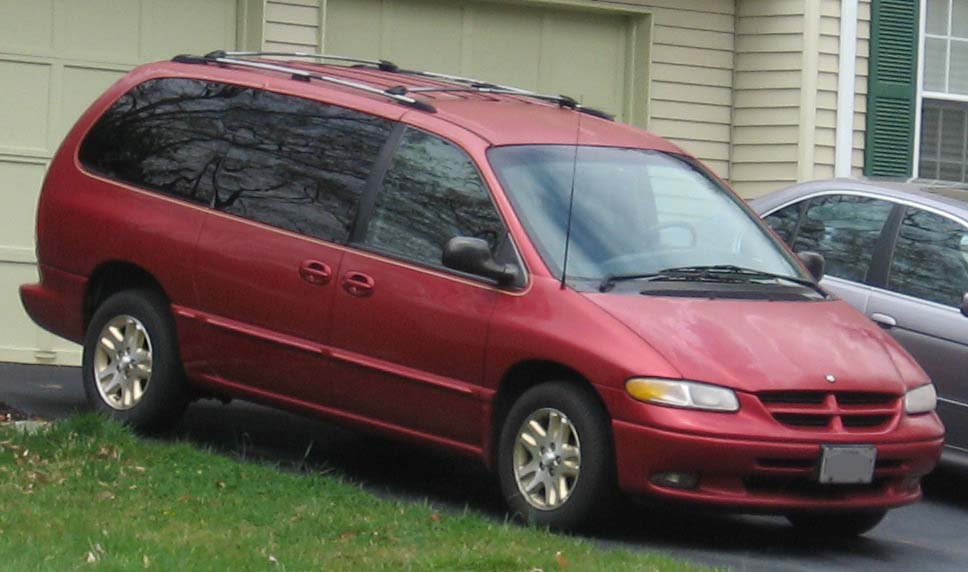 Major changes were made for the 2011 model year, both in styling and functionality. The suspension was heavily re-tuned, with both Dodge and Chrysler minivans gaining a larger front sway bar and new rear sway bar, increased rear roll center height, adjusted spring rates, a new steering gear, a revised front static camber setting, and lowered ride height. All three of the former engine choices were replaced by the new Pentastar 3.6-liter V6 with six-speed automatic transmission, now the sole powertrain choice for all models. Interior trim was restyled on both vans, in addition to major exterior revisions highlighted by the new "double-crosshair" grille on the Grand Caravan and a new chrome grille for the Town & Country. Other changes included extra sound insulation, acoustic glass, new seats, softer-touch surfaces, new LED ambient lighting and center console,and halogen projector headlamps with LED accents. The Chrysler models were adjusted so that instead of competing against equivalent Dodge trim levels, they were above Dodge in trim and features. In the US National Highway Traffic Administration (NHTSA)'s NCAP crash testing the 2010 Dodge Grand Caravan achieved a five star (top safety) rating in several categories. Both the 3.8 L and 4.0 L engines were paired with Chrysler's 62TE 6 speed automatic transmission with variable line pressure (VLP) technology (See Ultradrive#62TE). In Canada (2008–2010) the 3.3 L was the standard engine across the range, combined with the 4-speed 41TE automatic transmission. The 4.0 L engine and six speed combination was available as an option on only the top of the range SXT models. In 2011 the six speed transmission was specified as standard on the Town & Country.